The Three Generation Rule

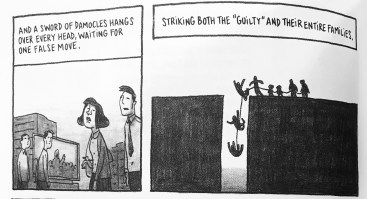
If a member of your family committed a crime, would you think you were as bad as them? What would others think of you?  North Korea is known for its punishments and it is also known as a strict country where your freedom is short and rare to have without feeling watched. After reading Guy Delisle’s Pyongyang, he mentions how his guide explains to him that “It’s like their permanent fear of landing in one of the re-education camps. A sword of damocles hangs over every head waiting for one false move.”  You could say it’s a manipulative and fear tactic on the citizens.IMG_1080
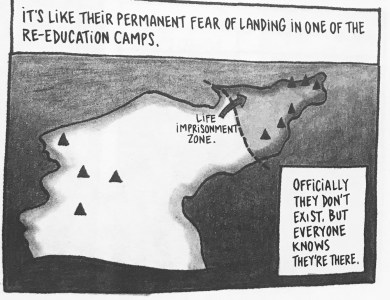
Out of all the laws and punishments that could be made, why is punishing the next three generations sound okay to do in North Korea? His drawing shows a group of people led by a rope between a gap. Showing if one falls in the gap, so do the rest for three generations.In North Korea, if one family member commits a crime whether it’s something small or major, the next three generations shall be punished for it. When the crime is committed, the person who made it happen is sent to a prison camp as well as their family. Any members born in the prison camp must remain there for life.When three generations grow into a fourth, the punishment is lifted from the family but not the prisoner themself depending on the crime. Though the main prisoner would most likely be executed already.
IMG_0997Something that can be connected to the three generation punishment are executions in North Korea. It’s a large connection because if the crime is something horrible (in their eyes), family members can be executed as well even if they’ve never done a bad thing in their life. Not only are executions taken place but public ones. Public executions can be shown to the citizens whether it’s  hanging, firing squad, or decapitation. In North Korea, public executions is a form of brainwashing and setting examples on others to the citizens. When a public execution is held, people of all ages as young as twelve years old must watch. Young children are encouraged to watch so they can become aware what could happen in their future if they were to turn their backs on their leader or commit an unforgivable crime. Since 2000, there have been a record of 1,400 public executions.

There are two questions that I, myself have. Why are the next three generations punished if a family member commits a crime? Not every family member is alike to one another.  Why are there public executions? I see it as a way to put fear into the citizens and set horrible examples onto the youth.
Making the Right Decisions

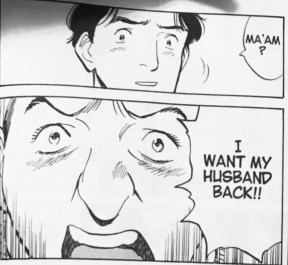
Have you ever had to make a decision that can change your career? Or even your whole life? Imagine saving a future serial killer’s life from the decision you’ve made. Our story takes place in 1986 Dusseldorf Germany, we meet Dr. Kenzō Tenma. Tenma is the top surgeon of the hospital and soon to be director. A construction worker who hurt his head needed immediate surgery but Tenma had to back out of the operation to work on an opera singer that needed more attention due to his fame. After the operation, Tenma cannot work on the construction worker still, the patient died before Tenma could work on him. Knowing that a patient of his has passed away, he feels a small wave of guilt until it grew larger when the wife of the construction worker begged and cried for Tenma to “bring her husband back”.

IMG_9311IMG_9309

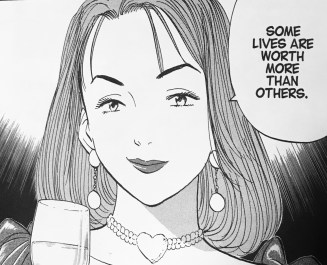
Tenma becomes slowly more upset about the situation as his day goes on. While on a date with Eva (His girlfriend), he tries to tell her his thoughts until she says, “Some lives are worth more than others.” My question for this is, why did Tenma fall in love with this woman? She’s obviously not Tenma’s type, Eva is full of herself while Tenma is very humble.

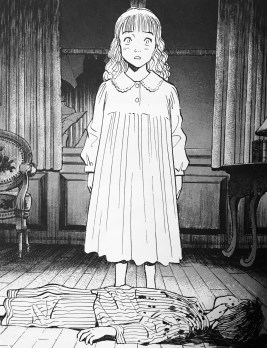
Throughout the night, police are called to a manor, revealing that a couple were shot dead and their children alive. The one child (Johan) being shot on the head, barely breathing while the daughter (Nina) stood above him, petrified with a gun in her hand. Both children are taken to the hospital in the night and Tenma rushes there to operate on the boy.

IMG_9318

Before operating on Johan, the mayor of Dusseldorf is in need of urgent surgery but Tenma refuses since he was working on the boy first. Johan makes it out alive but this leads to Tenma being demoted, he’s no longer the top surgeon of the hospital. If I were Tenma, I’d expose the hospital for it’s cruel behavior, seeing lives worth more than others.

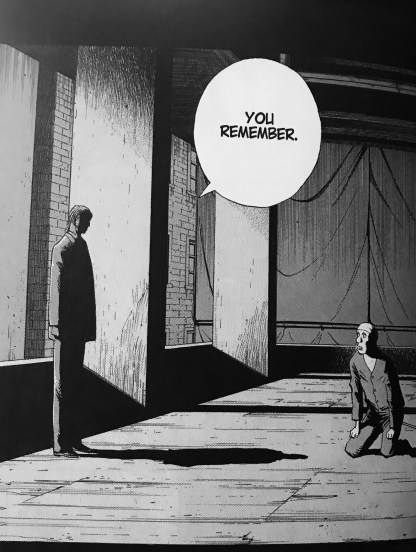
Eva left him for a new surgeon that took Tenma’s place. Tenma made a huge decision, that led to something he didn’t want but wanted at the same time. As Johan is healing, the director and a few doctors are then poisoned by gifted candy that was sent to the boy. When their bodies are found, both children are gone. The manga skips 9 years after the events occured. Couples have now been found dead all over Germany. Tenma is working on a patient named Junkers, Junkers claimed to have seen a…monster. He soon goes missing until Tenma soon finds him in an old parking lot building. Junkers is in front of a mysterious tall man, holding a gun.

IMG_9317

The man is revealed to be the young boy, Johan that Tenma saved 9 years ago. As the manga continues, Johan continues to kill innocent lives. This leads to questions though, did Tenma make the right decision? If he could know what the future would unfold, would he still have operated on Johan? Knowing the boy he saved turned out to be someone so dangerous, does Tenma have regrets? 

If you want to know characteristics of a serial killer, click the link

https://www.drphil.com/advice/fourteen-characteristics-of-a-serial-killer/

Artie’s Relationship with His Father

Not everyone has the most perfect relationship with their father. I, myself can say that I don’t have the best with mine. Nonetheless though if I’m interested in a story, I’ll listen no matter who’s telling it. It’s the same in Maus. Artie, the son of a Holocaust survivor (Vladek)is writing a book and is intrigued in hearing his father’s story on his survival. Vladek, doesn’t have the best attitude and relationship with his son. Artie finds his father to be rude and quite bothersome.

In the start of the story, Vladek begins his tale of his survival in the Holocaust. Artie is intrigued, the two look like that they have a fine father and son relationship. It starts to turn slightly when Artie is smoking and his father yells at him for missing the ashtray. Artie apologizes but his father carries it on a bit. We start to see how their relationship is taking a small turn.

img_7304 (1)

In the graphic novel, there are times where I actually feel bad for Artie for having to deal with his father to get through the story. When Vladek was done with the story (for the day), he decided to throw away Artie’s coat as if he didn’t put thought into how important it might be to his son. Artie reacts the same way anyone would if someone threw away a precious coat to them. Artie confronts him and asks him why. His father’s reason is that its too old and too big. Yet throughout the novel, we learn that Vladek doesn’t like spending money at all! Artie seems to be tired of his father but is only staying to hear the story for his own book that he is writing. Is it wrong for Artie to be spending time with his father only for the story? I don’t doubt that Artie loves his father but, he doesn’t want to tolerate his father’s actions.


Graphic Novel Rick or Television Rick?

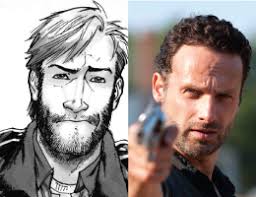
Usually, the book is always better than what’s on the television or movie screen. In this case, the television show is far better than the graphic novel. As someone who watched the show before reading the graphic novel, I couldn’t get interested in the book. In the beginning of the novel, Rick wakes up and wanders around the hospital before seeing the horde of zombies in the hospital’s cafeteria, his reaction is accurate when he sees them but then afterwards…what the hell kind of reactions does he give? The graphic novel Rick is so calm and collective after the hospital scenes! He’s a joke. 

images

In the television show, Rick gives genuine reactions towards what’s happening around him.  When Rick is wandering around his abandoned neighborhood, he comes across and meets Morgan and his son Duane…after he wakes up from them hitting him unconscious. There’s a big difference between the graphic novel Rick and the television show Rick. The Rick in the book jokes around with Morgan and doesn’t care much about Duane around a weapon when they’re at the police building. In the television show, Rick is very serious and when Duane wants to handle a gun, Rick reminds him that it isn’t a toy. In my opinion, Rick is more serious and accurate in the show than Rick in the graphic novel.

Rick is too calm…too much of a jokester and just annoying in a way to me in the graphic novel. Everyone around him is more serious about the situation than he is! Yes we could say that he wasn’t there when it first started and he needs to process it all in his head, but as someone who wakes up in the middle of a great zombie apocalypse, he should be freaking the hell out! In the television show, Rick barely makes a joke, he rarely smiles and he handles the situation like he life and those lives around him depended on it…(and it does). If I was placed in The Walking Dead universe, I would feel more safe around Rick Grimes from the television show than the graphic novel one.  

American Born Chinese…No Closure and Open Spaces! (Spoilers head).

imagesimagesimages

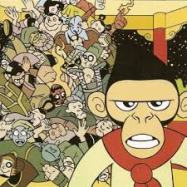
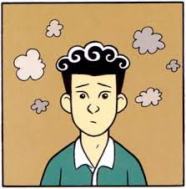
In American Born Chinese by Gene Luen Yang, it gives three separate stories. One story about a Monkey King trying to be accepted. Another is a young boy named Jin changing himself for a girl, and an embarrassing distant cousin named Chin-Kee. Throughout the story, all three stories connect and come as one. My problem with this story, is the ending and how the story gives you information on the characters without detail.


The ending doesn’t completely give the audience that is reading closure. Jin’s best friend (Wei-Chen) through the story, is the Monkey King’s son and that is never explained. In the beginning of it all, there is no mention of the Monkey King’s son. We’re meant to accept that Wei-Chen is suddenly related to the Monkey King. It would of been best if they gave the backstory for Wei-Chen. Was he adopted? Did the Monkey King have a wife that passed away? We’re left to think about it with no real answer. Did the author leave it a mystery for the reader to use their imagination?


During Jin’s sections of the story, we learn that he is from ChinaTown in San Francisco. It’s neat that we’re giving his backstory as to how he arrived to his new school. The children make fun of him and even the teacher has no respect for him due to him being Chinese. As his school career goes on, he befriends Wei-Chen. As their friendship continues and they become teenagers, Jin falls in love with a girl named Amelia. He changes himself for her but in the end, he doesn’t date her. Out of anger of not being with her, Jin kisses Wei-Chen girlfriend which leads to the end of their friendship.


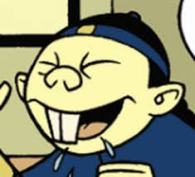
In the third story, a boy named Danny has a distant cousin from China that comes down to stay with Danny and his family. The cousin’s name is Chin-kee and throughout the story, Chin-kee embarrass Danny until he has enough at the end. The two begin to fight physically and it’s revealed that Chin-Kee is the Monkey King and Danny is Jin. Are we left with an explanation? Somewhat. In the last few pages, Jin and Wei-Chen are reunited but we are left at an abrupt end of them drinking boba tea. Gene Luen Yang should write a sequel that has the unanswered questions that the readers are left wondering. Could the author be leaving it for the reader to use their imagination?